
The Production AI Adoption Flywheel
Most AI adoption programs measure whether people use a tool. That is a weak proxy. The question for a technical organization is whether work changes shape: fewer handoffs, shorter review loops, better operational evidence, and more repeatable outcomes. This article describes the loop we use for production AI adoption at Mindthread.
Services
Production AI, Background agents, Engineering operations
Industry
Software teams, Enterprise engineering
The adoption gap
The short version: useful AI adoption compounds when one workflow becomes proof, the proof becomes reusable operating context, and the next workflow starts with better constraints than the first. Mindthread's version of the loop is assessment, bounded pilot, proof, packaging, and operation.
Many engineering organizations already have AI usage. Developers ask coding assistants for help. Product managers summarize calls. Support teams draft answers. The visible activity is real, but the workflows around it often remain unchanged: tickets still wait for triage, pull requests still need the same manual reconstruction, incident reviews still depend on scattered evidence, and architecture decisions still live in conversation history.
The gap is between individual acceleration and organizational throughput. A faster engineer helps the task in front of them. A production AI workflow changes the path a task takes through the system. It captures context, runs repeatable checks, proposes a bounded action, and hands a human a decision with enough evidence to approve, revise, or reject it.
That difference matters because adoption rarely scales through announcements. It scales when one team can point to a real workflow and say: here is the old path, here is the new path, here is the review evidence, and here is the part another team can reuse.
What repeats
The pattern is older than AI. Continuous delivery succeeded when release work moved from informal human coordination into versioned pipelines, automated checks, and small reversible changes. The same lesson appears in Martin Fowler's writing on feature flags: production change becomes safer when behavior can be exposed gradually and controlled at runtime.
Production AI adoption follows the same engineering logic. The model is only one component. The useful system includes a workflow boundary, a source of truth, a permission envelope, evaluation checks, and a human handoff. Without those parts, the organization gets scattered tool usage. With them, one successful workflow lowers the cost and perceived risk of the next.
We call that the Production AI Adoption Flywheel. It has five movements: assess, run a bounded pilot, prove, package, and operate.
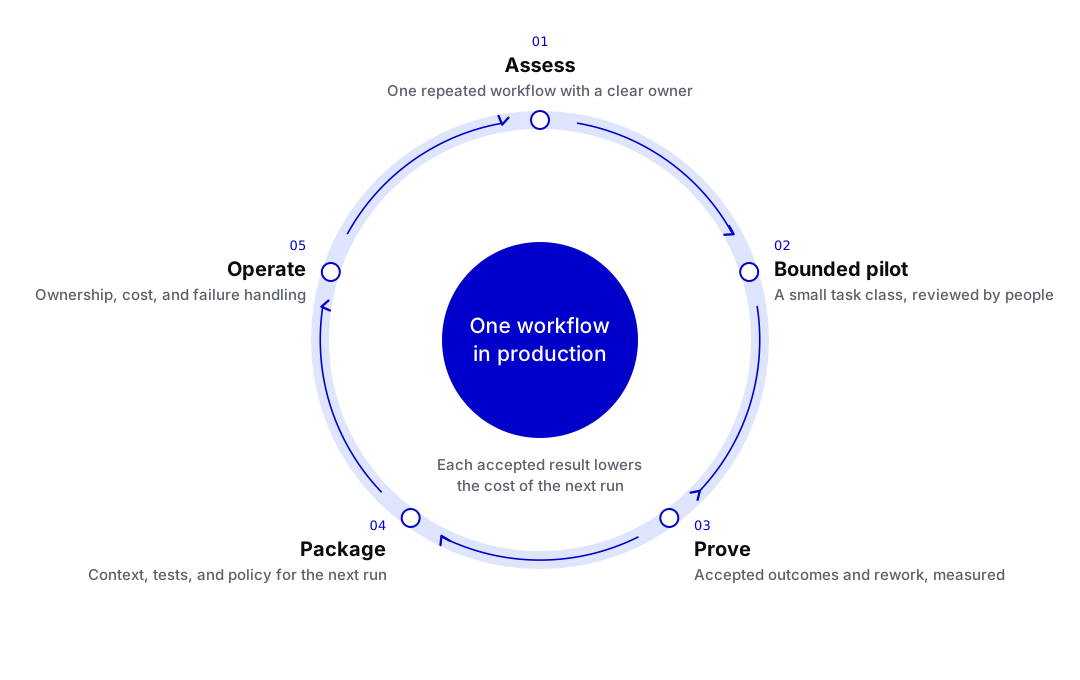
The flywheel
1. Assess one workflow
Start with work that already has a clear owner, a repeated path, and an outcome people can judge. Good candidates are ticket triage, dependency upgrades, flaky-test investigation, log correlation, support classification, documentation repair, or small migration tasks. Weak candidates have vague acceptance criteria, hidden production access, or a decision that only one senior person can evaluate.
The assessment should produce a short workflow map: inputs, systems touched, human judgment points, expected output, failure modes, and the evidence a reviewer needs. If that map cannot be written in a page, the first workflow is too large.
2. Run a bounded pilot
A serious pilot is small by design. For software teams, we prefer one repository, one class of task, focused tests, no production access, and a draft pull request as the handoff. The agent can investigate, edit, run checks, and explain its decision path. A human still owns review and merge.
This boundary is what lets the organization learn without pretending the agent is already a colleague. The pilot tests the whole operating system around the model: task readiness, repository context, permissioning, review burden, failure recovery, and cost.
3. Prove the result
Proof means accepted outcomes. Demo quality is insufficient. Count how many attempted tasks became reviewable outputs, how many were accepted after human review, how many needed rework, and why the rest stopped. Also measure human minutes per accepted outcome, review-ready lead time, cost per accepted outcome, change failure or revert rate, and common blocker reasons.
The point is to learn where the constraint really sits. Sometimes the model is weak. More often, the ticket is underspecified, tests are expensive to run, local setup is brittle, or the repository lacks the operational context needed for a correct change.
4. Package what worked
Packaging turns one successful workflow into a starting point for the next one. Capture the task shape, repository setup, test command, code ownership rules, allowed tools, review checklist, prompt context, failure taxonomy, and examples of accepted and rejected outputs. The package should be concrete enough that a second team starts from an operating baseline instead of reconstructing the pilot from memory.
workflow: dependency-update-draft-pr
owner: platform-team
scope:
  repositories: [billing-api]
  task_shape: one library update with existing tests
  production_access: none
handoff:
  output: draft_pull_request
  reviewer: code_owner
checks:
  required: [unit_tests, affected_integration_tests, lint]
  optional: [security_advisory_notes]
metrics:
  - accepted_task_rate
  - human_minutes_per_accepted_outcome
  - review_ready_lead_time
  - rework_count
  - cost_per_accepted_outcome
stop_reasons:
  - missing_acceptance_criteria
  - local_setup_failed
  - test_failure_unrelated
  - reviewer_rejected_change
5. Operate the workflow
Once a workflow produces accepted outcomes, treat it as production software. It needs an owner, a scope, an escalation path, cost visibility, quality metrics, and a retirement path. The operating model is what prevents useful experiments from turning into private scripts with unclear authority.
Operation also feeds the next assessment. Every stop reason points to a missing piece of organizational context. Every accepted result creates a concrete example. Every reviewer comment improves the package. That is where the flywheel starts to compound.
Breadth and depth
Adoption has two dimensions. Breadth is how many teams use AI in their work. Depth is how much of a specific workflow has moved into a governed AI-assisted path.
Breadth finds candidates. It gives more people enough experience to notice where work is repetitive, evidence-heavy, or slow because context is scattered. Depth captures value. It moves a workflow from occasional assistance into a repeatable path with checks, handoffs, and measurement.
| Adoption mode | What it improves | Where it stalls |
|---|---|---|
| Broad tool usage | Language, confidence, discovery of candidate workflows | Operational throughput barely moves if every task still follows the old path |
| Deep workflow automation | Accepted outcomes, cycle time, review quality, repeatability | Value stays local if the package cannot move across teams |
| Breadth with depth | More teams find work worth changing, and proven patterns spread faster | Governance and ownership must keep up with reuse |
Technical leaders usually need both. Broad access without workflow redesign becomes a productivity anecdote. Deep automation inside one team becomes a local optimization. The compounding effect appears when successful depth is packaged so breadth has something concrete to adopt.
What Mindthread builds
Our work starts at the workflow boundary. We look for repeated engineering or operations work where the current path is slow because context is fragmented: backlog grooming, draft pull requests, runbook execution, incident evidence gathering, support classification, or migration work. Then we design the smallest version that can produce a reviewed outcome.
A typical first engagement has four phases:
- Assessment. Select one workflow, define success criteria, map risks, and decide what evidence a reviewer needs.
- Bounded pilot. Run a small number of real tasks with explicit access limits and human review.
- Production project. Package the working setup with tests, policy, ownership, and metrics.
- Operate. Monitor accepted outcomes, cost, stop reasons, rework, and failure rate while expanding to adjacent workflows.
This is intentionally narrow. The first useful system is usually a background agent that can take a well-formed ticket and return a draft pull request, an incident evidence pack, or a classified support queue. The handoff is reviewable. The reviewer sees the change, the checks, the decision trail, and the known uncertainty.
Failure modes
The flywheel breaks when teams confuse activity with adoption. Login counts and message volume show exposure. They do not prove that a workflow changed.
Tasks are too vague
Agents need bounded work. A ticket that asks someone to "improve onboarding" is a discussion starter. A ticket that names the affected repository, expected behavior, test surface, and acceptance criteria is a candidate for a draft-PR workflow.
Review cost is ignored
A workflow that creates many plausible outputs can still be expensive if reviewers must reconstruct the reasoning from scratch. Require evidence in the handoff: commands run, files changed, checks passed, assumptions made, and known limitations.
The package is only a prompt
A prompt is rarely enough. Reuse depends on repository setup, permissions, test commands, examples, rejection reasons, and ownership rules. Treat prompt text as one artifact inside a larger operating package.
Governance arrives late
The second or third successful workflow is when shadow process begins. Decide early who owns the agent, who can change scope, what it may access, how costs are tracked, and how to shut it down.
Where to start
Pick one workflow with enough repetition to matter and enough structure to review. Write down the current path. Run five real attempts with tight scope. Count accepted outcomes rather than completed conversations. Inspect every stop reason. Package the context only after a reviewer accepts the result.
The first turn of the flywheel should feel almost disappointingly small. That is a good sign. A small workflow can be measured, corrected, and reused. Once it survives contact with real review, the next team starts ahead.
Production AI adoption is less about persuading everyone to use a tool and more about making one piece of work legible enough for software to assist safely. Repeat that enough times and adoption starts to compound.
FAQ: Production AI adoption
What is the Production AI Adoption Flywheel?
A practical adoption loop for technical organizations: assess one workflow, run a bounded pilot, prove accepted outcomes, package the working setup, and operate it with ownership and metrics.
How is this different from AI training?
Training helps people use tools. The flywheel changes a workflow so AI-assisted work becomes reviewable, repeatable, measurable, and safe to reuse across teams.
What should the first pilot produce?
A reviewed artifact: a draft pull request, an incident evidence pack, a classified support queue, or another output where a human can judge correctness with clear evidence.
What should teams measure?
Accepted task rate, human minutes per accepted outcome, review-ready lead time, rework, change failure or revert rate, cost per accepted outcome, and stop reasons.